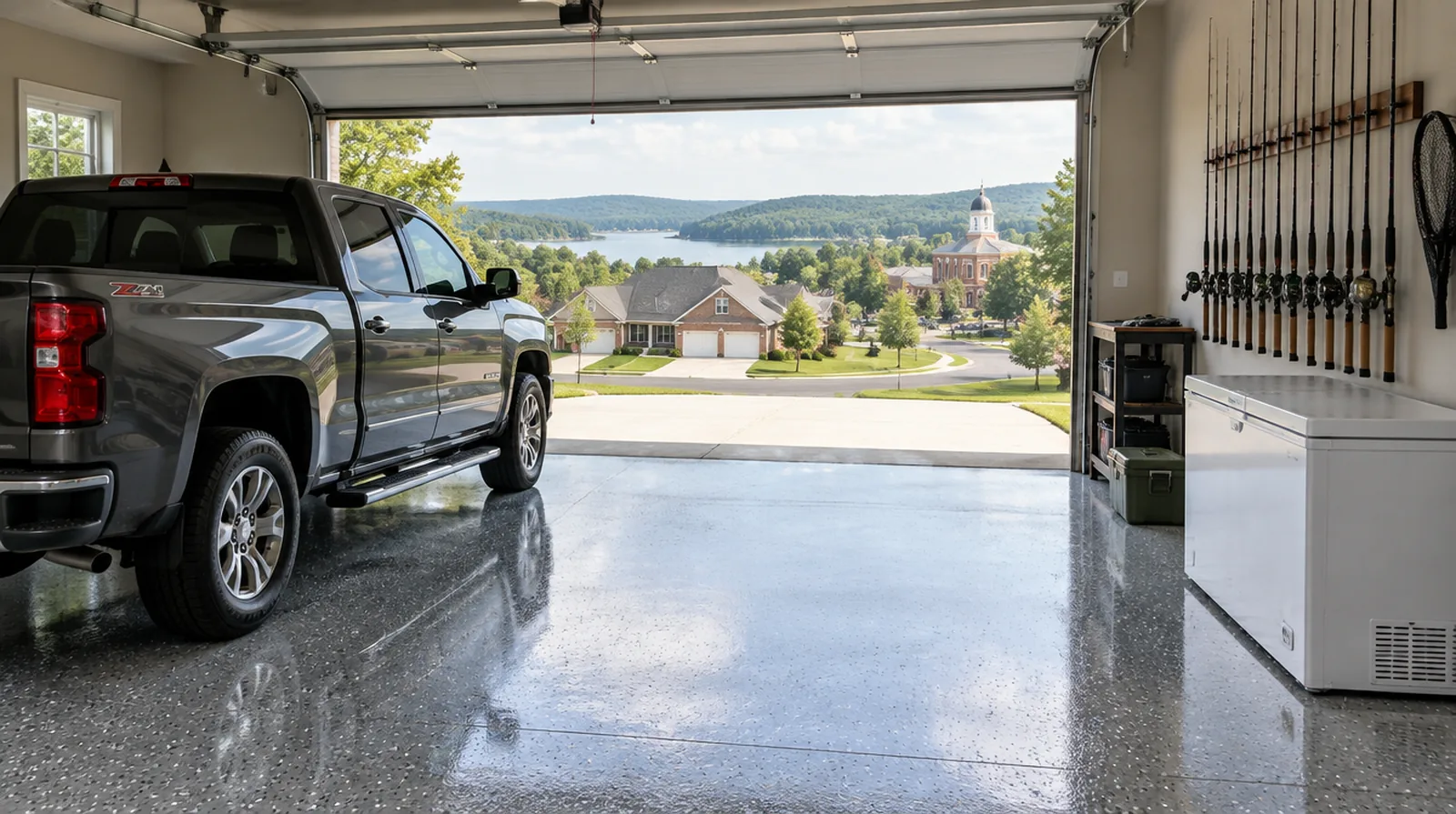
What happens to bare garage concrete here
A bare slab is a sponge. In a lake town, it soaks up water dripping off boats, trailers and coolers. In farm country, it soaks up mud, fertilizer and diesel. On humid mornings it sweats, and that moisture carries dirt deeper into the pores. Over a few years the result is a dark, blotchy floor that never looks clean and slowly sheds dust. A garage coating stops the absorption, so spills sit on top and wipe away.
Step one: test and grind
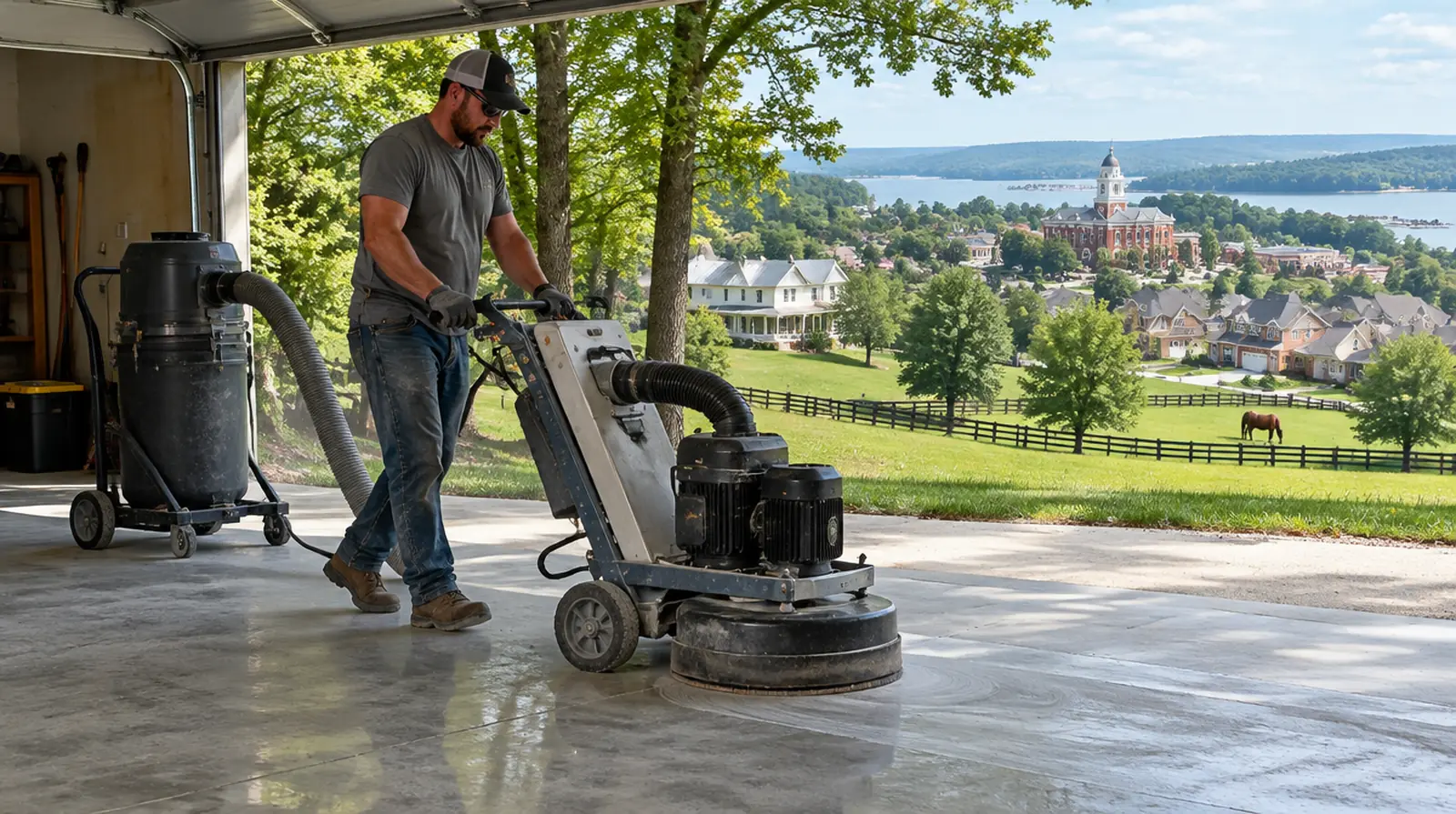
Before anything else, we check moisture in the slab and note the dew point. Then we grind the entire floor with diamond tooling. Grinding takes off the smooth, weak top layer and any sealers or curing compounds, and leaves a texture the primer can lock into. Our grinders are tied to HEPA vacuums, so dust stays in the bag instead of on your shelves. Old paint or failed kits are removed down to sound concrete.
Step two: fix the slab
Cracks are opened slightly and filled with repair material suited to whether they move. Chipped edges at the garage door, spalled areas from old salt use and small pits are patched and ground smooth. Control joints can stay as clean lines or be filled for a continuous look. This is the work that makes the finished floor look flat and professional rather than like paint over damage.
Step three: build the system
Our standard garage floor uses a penetrating epoxy primer, a colored base coat with a full broadcast of vinyl flake, and a clear polyaspartic topcoat. When moisture readings are higher than normal, we switch to a moisture-tolerant primer so vapor does not push the coating off. The polyaspartic topcoat resists hot tire pickup, fuel and sunlight, so it will not yellow when the door stays open all afternoon.
Color and texture
Mid-tone blends with grays, tans and browns are popular here because they hide the reddish clay dust that tracks in from yards and gravel roads. Lighter blends brighten garages used as workshops. We bring sample boards so you can see colors in your own light. Traction can be increased with fine aggregate in the topcoat, which we often recommend near entry doors and where wet trailers park.
Garages that do double duty
Many of our customers use the garage as a home gym, a second fridge and freezer space, a place to work on bikes or a hangout during football season. A coated floor makes that space feel like part of the house. We can coat steps into the home, add a cove base along walls to keep water from sitting at the edges, and coat small adjoining storage rooms at the same time.
Schedule
- First day: testing, grinding, repairs, primer and flake base.
- Second day: scrape, vacuum and topcoat.
- Walk on it: about a day after topcoat.
- Park on it: two to three days, depending on temperature.
Fast-cure polyaspartic systems can shorten that schedule when you need the garage back quickly.
Taking care of it
Hose off mud and rinse with a mild soap. A squeegee helps push water out the door. Use a pad under trailer jacks, kickstands and jack stands. Clean up fuel, brake fluid and fertilizer when they spill. With that routine, the floor stays bright for years and can be refreshed with a new topcoat when it eventually dulls.
Questions
Can a wet boat sit on the floor?
Yes. The coating is waterproof; just keep standing water from pooling for days.
Will the coating bubble?
Bubbling usually comes from moisture or poor prep. We test and prepare to prevent it.
Do I have to clear the garage?
Yes, the floor must be empty during the job.
Book a garage visit
Contact us for a free measurement and written quote.
to get a garage floor quote.
Call (615) 527-8443 for a free estimate.